Layer 3 Remote Port Mirroring-ERSPAN Mode
- 0 Followed
- 0Collected ,1Browsed

Network Topology
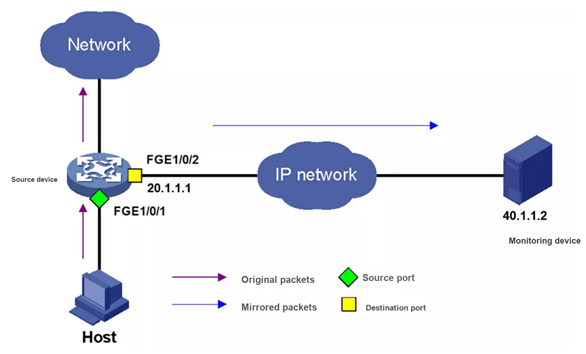
ERSPAN-based Layer 3 remote port mirroring encapsulates the mirrored packet in a GRE packet with protocol number 0x88BE and routes it to the remote monitoring device. It only has to be configured on the source device, together with a unicast routing protocol on all devices so that they can reach each other at Layer 3.
The source device copies the packets that pass through the source port, adds the ERSPAN encapsulation to the copy — the encapsulated source IP address is the IP address of the destination port, and the destination IP address is that of the monitoring device — and the packet is routed over the IP network to the monitoring device, which de-encapsulates it and analyses the mirrored packets inside.
The packets that reach the monitoring device are encapsulated, so the monitoring device must be able to de-encapsulate them. Before using this mode, check the product configuration guide to confirm that the switch supports the feature.
Configuration Steps
Configuration example — source device
Step 1: Create local mirroring group 1
[Device] mirroring-group 1 local
Step 2: Set the source port of group 1 to FGE1/0/1 and the destination port to FGE1/0/2; the destination IP address of the mirrored packets is 40.1.1.2 and the source IP address is 20.1.1.1
[Device] mirroring-group 1 mirroring-port fortygige 1/0/1 inbound
[Device] mirroring-group 1 monitor-port fortygige 1/0/2 destination-ip 40.1.1.2 source-ip 20.1.1.1
Key Configuration
Before using this mode, check the product configuration guide to confirm that the switch supports the feature.