Flow Mirroring
- 0 Followed
- 0Collected ,2Browsed

Network Topology
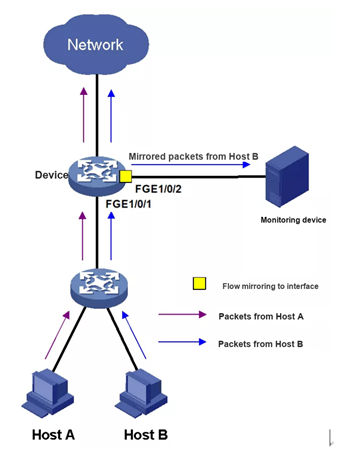
Flow mirroring is implemented with QoS: the device first matches the packets to be mirrored with a traffic class, and then copies the matching packets to the specified destination with a traffic behaviour. Because the match conditions are flexible, packets can be distinguished very precisely and only the selected ones are mirrored.
Flow mirroring can send the copy to many kinds of destination — an interface, a monitoring group, the CPU, the gRPC or INT processor, and so on. Mirroring to an interface is used as the example here.
Configuration Steps
Step 1: Create an IPv4 advanced ACL and define a rule that matches the packets sourced from Host B
[Device] acl advanced 3000
[Device-acl-ipv4-adv-3000] rule permit ip source 192.168.2.0 0.0.0.255
Step 2: Create traffic class tech_c and use ACL 3000 as the match rule
[Device] traffic classifier tech_c
[Device-classifier-tech_c] if-match acl 3000
Step 3: Create traffic behavior tech_b and configure flow mirroring to interface FGE1/0/2
[Device] traffic behavior tech_b
[Device-behavior-tech_b] mirror-to interface fortygige 1/0/2
Step 4: Create QoS policy tech_p and associate the traffic class with the traffic behavior
[Device] qos policy tech_p
[Device-qospolicy-tech_p] classifier tech_c behavior tech_b
Step 5: Apply QoS policy tech_p to the inbound direction of interface FGE1/0/1
[Device] interface twenty-fivegige 1/0/1
[Device-Twenty-FiveGigE1/0/1] qos apply policy tech_p inbound
Key Configuration
None